By Dr. Om Patil – Orthopedic Spine Surgeon, Mumbai
Sleep is when your body repairs, rejuvenates, and prepares for the next day. But if your sleeping position is wrong, the hours you spend in bed can actually harm your spine instead of healing it. As a spine surgeon, I’ve seen many patients whose neck or back pain started — or worsened — because of how they slept.
In this article, I’ll guide you through the best sleeping positions for a healthy spine and some simple tips to protect your back at night.
Why Sleeping Position Matters for Your Spine?
Your spine has a natural “S” shape with gentle curves in your neck, mid-back, and lower back. When you sleep, you should try to maintain these curves. If your position bends or twists the spine unnaturally for hours, it can strain muscles, ligaments, and discs — leading to pain, stiffness, or even nerve irritation.
The Best Sleeping Positions for Spinal Health
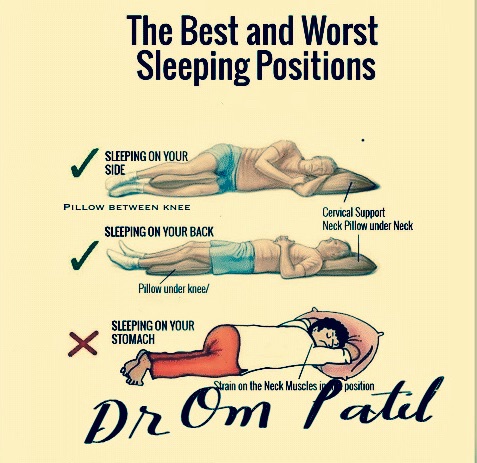
1. Sleeping on Your Back – The Gold Standard
If your goal is to keep the spine in its most neutral position, sleeping on your back is the best option.
Why it’s good: It evenly distributes weight and prevents unnatural twisting. Tip: Place a small pillow under your knees to reduce pressure on your lower back. Neck support: Use a medium-thick pillow that supports the natural curve of your neck.
2. Sleeping on Your Side – The Runner-Up
If you’re not comfortable sleeping on your back, side sleeping is the next best choice.
Why it’s good: Keeps the spine aligned if your knees are slightly bent. Tip: Place a pillow between your knees to prevent pelvic rotation and lower back strain. Neck support: Use a pillow that fills the gap between your shoulder and ear.
3. The Fetal Position – For Disc Comfort
Some patients with herniated discs or nerve pain feel relief in the fetal position.
Why it’s good: Opens up spaces between vertebrae, easing nerve pressure. Tip: Curl up gently without tucking too tightly, to avoid restricting breathing.
Positions to Avoid
❌ Sleeping on your stomach – This puts your neck in a twisted position for hours and increases strain on your lower back.
❌ Twisting your spine – Avoid placing one leg up high or rotating your upper body while sleeping.
Choosing the Right Mattress and Pillow
Mattress: Medium-firm is best for most people; it supports the spine while allowing slight contouring.
Pillow: Should maintain neck alignment — not too high, not too flat. Memory foam or orthopedic pillows are good options.
When should I Replace my mattress and pillow? Mattresses usually need replacing every 7–10 years; pillows every 1–2 years.
Quick Bedtime Checklist for a Healthy Spine
✅ Keep spine in a neutral position
✅ Support knees and neck with the right pillows
✅ Avoid stomach sleeping
✅ Use a comfortable, supportive mattress
✅ Stretch gently before bed to relax muscles
Final Word from Dr. Om Patil
Your spine works hard all day to support your body — give it the rest it deserves at night. By making small adjustments to your sleeping position and bedding, you can prevent unnecessary back and neck problems, wake up refreshed, and maintain long-term spinal health.
About the Author
 Spinewala Blog