
Slip Disc: What It Really Means, When to Worry, and When You Need Treatment
By Dr. Om Patil | SpineWala® — Endoscopic & Minimally Invasive Spine Surgeon, Mumbai
You bend down to pick up something from the floor.
Suddenly, you feel a sharp pain in your lower back.
Over the next few hours, the pain begins travelling into your buttock and down your leg. You may feel tingling in your foot. Sitting becomes uncomfortable. Walking becomes difficult.
Then comes the most common question:
“Doctor, is my disc slipped?”
The term slip disc sounds frightening. But the reality is often very different.
A slip disc does not necessarily mean that your spine is damaged permanently. And it certainly does not automatically mean that you need surgery.
Understanding what is actually happening is the first step towards choosing the right treatment.
What is a slip disc?
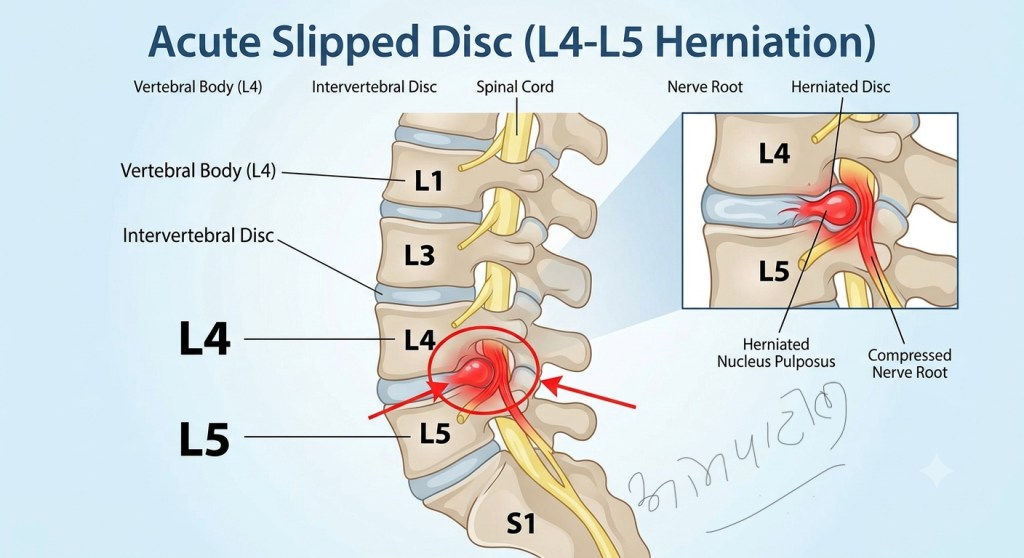
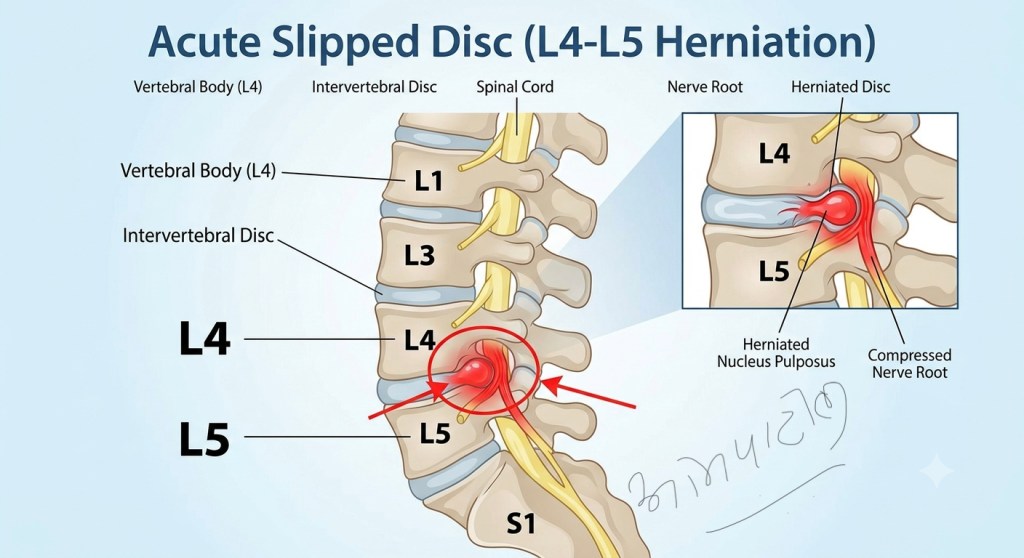
Your spine is made up of individual bones called vertebrae. Between these bones are soft structures called intervertebral discs.
Think of a disc as a small cushion between two vertebrae.
It has a tough outer layer and a softer inner portion.
With ageing, repetitive stress, injury or sometimes without any obvious reason, the outer portion can develop a weakness or tear.
The inner material may then push outward.
This is commonly called a slip disc.
Medically, we usually call it a disc herniation, disc protrusion or disc extrusion, depending on its appearance.
The important part is not simply whether the disc is bulging.
The important question is:
Is the disc pressing on a nerve and causing your symptoms?
That distinction changes everything.
Why does a slip disc cause leg pain?
This is where the story becomes interesting.
The spinal nerves leave the spine through small openings and travel into your legs.
If a herniated disc presses against one of these nerves, the pain may travel along the path of that nerve.
You may experience:
Back pain → buttock pain → thigh pain → calf pain → foot pain
This is commonly called sciatica.
You may also experience:
- Tingling
- Numbness
- Burning or electric-shock-like pain
- Muscle weakness
Sometimes, interestingly, the leg pain is much worse than the back pain.
That is because the irritated nerve can be extremely sensitive.
But here is something many people don’t know
You can have a slip disc without having pain.
MRI scans often show disc bulges or degeneration even in people who have no symptoms.
This is why treating an MRI report instead of treating the patient can lead to unnecessary treatment.
A good spine evaluation asks three questions:
1. What symptoms does the patient have?
2. What does the neurological examination show?
3. Does the MRI finding actually explain those symptoms?
When these three pieces fit together, we have a much clearer diagnosis.
Do you need an MRI immediately?
Not necessarily.
If you have uncomplicated back pain without neurological symptoms or warning signs, your doctor may initially recommend conservative treatment.
An MRI becomes particularly useful when:
- Leg pain is severe or persistent
- There is numbness or weakness
- Symptoms are not improving
- Surgery or an injection is being considered
- There are concerning neurological findings
An MRI can show the location and severity of disc pathology and whether a nerve is being compressed.
But remember:
An MRI is a map—not the diagnosis by itself.
Can a slip disc heal without surgery?
Yes, many can.
This is one of the most reassuring facts about disc herniation.
Depending on the patient’s symptoms and neurological status, treatment may begin with:
- Appropriate medication
- Activity modification
- Physiotherapy
- Exercise-based rehabilitation
- Lifestyle modification
- Selected spinal injections
The aim is to control pain, allow the irritated nerve to recover and gradually restore normal activity.
Many patients improve without an operation.
Then when is surgery necessary?
This is where individual assessment becomes important.
Surgery may be considered when significant symptoms persist despite appropriate non-operative treatment or when there is significant neurological compromise.
More urgent assessment is required when there is:
Progressive weakness
For example, increasing difficulty lifting the foot or walking on the toes or heels.
Severe, persistent nerve pain
Particularly when pain remains disabling despite appropriate treatment.
Cauda equina symptoms
New bladder or bowel dysfunction, saddle-area numbness or severe/progressive neurological deficits require urgent medical assessment.
The decision should never be:
“MRI shows a disc → therefore surgery.”
It should be:
“The patient has symptoms and examination findings caused by this disc → what is the safest and most effective treatment?”
What is endoscopic surgery for a slip disc?
Modern spine surgery has evolved significantly.
For appropriately selected patients, full-endoscopic spine surgery can remove the offending disc fragment through a small working channel.
Depending on the location and anatomy of the disc herniation, different approaches—including transforaminal or interlaminar approaches—may be used.
The basic objective remains simple:
Decompress the nerve while minimizing unnecessary tissue disruption.
The procedure is performed using specialized endoscopic visualization, allowing the surgeon to see the nerve and surrounding structures during decompression.
However, endoscopic surgery is not automatically the best operation for every patient.
The technique should be chosen according to the patient’s anatomy, pathology and surgical requirement—not simply because it is newer.
What about spinal fusion?
This is an important misconception.
Most uncomplicated lumbar disc herniations do NOT require fusion.
If the primary problem is a focal disc herniation compressing a nerve, the surgical objective is usually nerve decompression, not automatically fusion.
Fusion may be considered in selected situations where there is an additional problem such as instability, significant deformity, recurrent pathology with appropriate indications, or another structural reason requiring stabilization.
The treatment should therefore be individualized.
How long does a slip disc take to recover?
There is no single answer.
Recovery depends on:
- The size and location of the disc herniation
- Degree of nerve compression
- Duration of symptoms
- Presence of weakness
- Overall health
- Physical activity and rehabilitation
- Type of treatment
Pain may improve before numbness or weakness.
And nerve recovery can sometimes continue for considerably longer after the pressure has been relieved.
This is why early assessment of significant neurological symptoms is important.
Can you prevent a slip disc?
You cannot eliminate every risk.
Disc degeneration is part of the natural ageing process.
But you can improve the health and resilience of your spine by:
Stay active.
Regular walking, strength training and appropriate core conditioning can help maintain physical capacity.
Maintain a healthy body weight.
Learn proper lifting mechanics.
Avoid prolonged inactivity.
Do not ignore persistent neurological symptoms.
And perhaps most importantly:
Don’t let fear of movement control your life.
A healthy spine is not a spine that never bends.
It is a spine that is strong, mobile and appropriately conditioned for the demands you place on it.
The biggest mistake people make
When someone hears the words “slip disc,” they often immediately think:
“I need surgery.”
Someone else may say:
“Never have surgery. It will make your spine weak.”
Both statements are oversimplifications.
The truth lies somewhere in between.
Some patients recover completely without surgery.
Some patients genuinely benefit from surgery.
And a small group of patients need urgent intervention because of neurological deterioration.
The right treatment is the treatment that matches the patient—not the label.
When should you see a spine specialist?
Consider an evaluation if you have:
- Back pain associated with leg pain
- Persistent sciatica
- Numbness or tingling
- Leg or foot weakness
- Recurrent episodes of severe back pain
- Symptoms that interfere with walking, sleeping or working
- Persistent symptoms despite conservative treatment
And if you develop new bladder or bowel problems, saddle numbness, or rapidly worsening weakness, seek urgent medical attention.
Your MRI is not your destiny
Perhaps the most important message I want patients to take away is this:
You are not your MRI report.
A scan may show a disc bulge.
But your treatment should be based on the person sitting in front of the doctor—their symptoms, examination, lifestyle, expectations and imaging.
The goal is not to perform surgery because a disc looks abnormal.
The goal is to identify the actual pain generator and choose the least invasive treatment that can safely achieve the desired result.
Worried that your “slip disc” needs surgery?
Don’t decide based on an MRI report alone.
If you have persistent back pain, sciatica, numbness or weakness, a proper clinical evaluation can help determine whether your symptoms are actually coming from a herniated disc—and whether you need medicines, physiotherapy, injections, endoscopic decompression or another treatment.
Dr. Om Patil — SpineWala®
Endoscopic & Minimally Invasive Spine Surgeon, Mumbai
📍 Mumbai
🩺 Specialist in endoscopic spine surgery and minimally invasive treatment of spinal disorders.
If you have an MRI report, symptoms, or a diagnosis of “slip disc” and are unsure what to do next, book an evaluation with Dr. Om Patil.
Book appointment now 9819191896
Your spine deserves a diagnosis—not just a scan.
Share this article
Know someone who has recently been told, “You have a slip disc”?
Share this article with them. It may help replace fear with understanding.
 Spine Surgeons Notes
Leave a comment